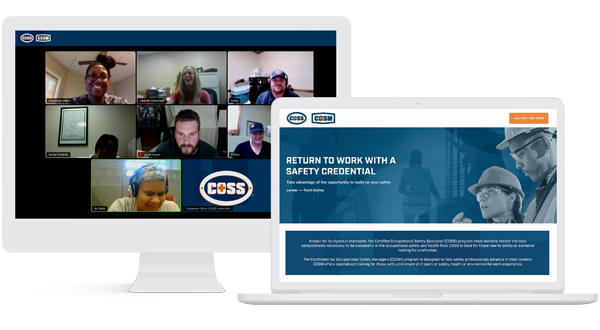
The COSS Recertification process helps ensure that COSS graduates maintain the necessary safety and health training to remain current in their field and/or profession.
Back to the TopAs a COSS Graduate, you must participate in professional development activities after your initial COSS certificate, and report such activities every three years. You must earn 6.0 CEUs or 60 contact hours every three years, in the area of safety and health and/or management. All CEUs or contact hours must be earned within the Recertification cycle to which they apply. CEUs and contact hours will be discussed further in the "Understanding CEUs" and "Understanding Contact Hours" sections of this guide. Failure to meet this requirement will result in loss of your COSS certificate.
Only active COSS Instructors are allowed to earn less than 6 CEUs or 60 Contact Hours. Active COSS instructors must earn at least 2.4 CEUs or 24 contact hours every three years.
CEUs or contact hours in excess of those required for renewal for a current Recertification cycle cannot be carried over to the next recertification cycle. CEUs or contact hours must be issued during the current three-year Recertification cycle.
Back to the TopYour COSS certificate will be renewable every three years. Your first initial certificate will actually extend beyond three years. It will expire on December 31 of the third full year following the beginning of your COSS certificate. See Table below for illustration.
| DATE COSS CERTIFICATE WAS RECEIVED | COSS CERTIFICATE EXPIRATION DATE |
| January 1, 2010 – December 31, 2010 | December 31, 2013 |
| January 1, 2011 – December 31, 2011 | December 31, 2014 |
| January 1, 2012 – December 31, 2012 | December 31, 2015 |
| January 1, 2013 – December 31, 2013 | December 31, 2016 |
| January 1, 2014 – December 31, 2014 | December 31, 2017 |
You must report your CEUs or contact hours by December 31st of the third full year of your Recertification cycle. Your Recertification Worksheet and registration form must be postmarked or received by fax no later than December 31st of the year your certificate expires.
Back to the TopCOSS graduates must keep track of their own Recertification CEUs or contact hours, compile all supporting documentation, and report at the end of the Recertification cycle. COSS Management will keep graduates informed about Recertification requirements, notify them when their cycle will end, and provide the Recertification Worksheet and Registration Form, and instructions.
Back to the TopThe Recertification Cycle end date appears on the annual reminder. In the first quarter of each year, you will receive a reminder letter or email that will state when your recertification cycle ends. Each year you will also receive a contact information update sheet, which you will use to notify COSS Management of any updated contact information, such as address, phone number or email address changes. On your third full year of certificate, you must submit a recertification worksheet and registration form. On, or before, December 31st of your expiration year, you will need to submit a total of $135 in the form of credit card, company check, or money order (personal checks cannot be accepted) for recertification, along with your worksheet and registration form.
The Recertification Fee is waived for active COSS Instructors only.
Back to the TopIt is very important to set up a personal procedure for tracking Recertification CEUs or contact hours. You will want to keep this Recertification Guide, your supporting documents, and a running list of Recertification CEUs or contact hours earned.
A good time to check your records is when you receive the annual reminder letter for your certificate. Keeping accurate records will make it easy to prepare the Recertification Worksheet at the end of your three-year Recertification cycle, and will make it easy to verify CEUs or contact hours claimed, should you get selected for an audit. At this point, it is also important to update any changed contact information so COSS Management may notify you of any COSS related information.
Information about what documentation COSS Management will accept to verify CEUs or contact hours claimed appears in this document under "Understanding CEUs". Be sure to keep documentation supporting your claim for CEUs or contact hours. You will have to submit supporting documentation only if you are audited, at which point, COSS Management will request supporting documents to verify the CEUs or contact hours you claim.
Complete the Recertification Worksheet and Registration Form and fax it, or mail it to COSS Management, at the following address:
10099 N. Reiger Rd.
Attention: COSS Operations Supervisor
Baton Rouge, LA 70809
Fax: 225-766-1099
Phone: 877-610-COSS
Do not send supporting documents with your Recertification Worksheet.
Proof of CEUs or contact hours earned is not required with the original Recertification Worksheet. Documentation of CEUs or contact hours earned will be required only if you are notified that your Worksheet is being audited.
The auditing process ensures that a graduate verifies the CEUs or contact hours claimed on a Recertification Worksheet. COSS Management will randomly select 25% of the total Recertification reports that year for audit. Individuals selected will receive a notice that will explain how to submit verification, and when it is due.
Back to the TopContinuing education courses provide one of the main methods for keeping up with professional practice. Both the length and rigor of a course contributes to its value.
The Recertification program for COSS uses the recognized continuing education credit system. For many continuing education courses, the providers ensure that they comply with national standards for continuing education courses established by the International Association for Continuing Education and Training
Courses complying with IACET standards can award Continuing Education Units (CEUs). COSS Management does not evaluate courses for CEU credit. We rely on compliance with IACET standards to help ensure quality in educational offerings and recognizes the CEU as a measure of course credit.
IACET publishes the rules for CEUs. CEUs are widely used and accepted in continuing education in the U.S.
Back to the TopSome safety and health classes or seminars that you participate in may not offer official CEUs. In these instances, you will need to accurately record the number of contact hours you spend in the training. For example: you attended a fall protection seminar at an expo from 9:00 a.m. - 11:00 a.m., but you were not issued CEUs for the seminar. In this situation you would count the number of actual hours you were in the training. In this example, you would be credited for 2 contact hours. As documentation of your attendance (if documentation is requested), you would need to provide a signed roster or attendance sheet and an agenda (or other meeting information) as proof of your attendance.
Some college credits may count as contact hours. For example, if you take a 3 hour SAFETY & HEALTH college class (elective/non-S&H related courses are not accepted) for 15 weeks, that would give you 45 contact hours (3 hours x 15 weeks). A passing grade on an end of semester report card, as well as your degree program’s list of required courses would serve as proof of your attendance (if documentation is requested).
Back to the TopMost graduates will acquire both CEUs and Contact Hours within the three year recertification cycle. This may make it hard to count the required CEUs and/or Contact Hours. Therefore, COSS Management recommends that you convert all CEUs to contact hours, and count the contact hours. You would do this by multiplying the number of CEUs by 10 to get the Contact Hours. For instance, if you take a class that offers 4.0 CEUs, you would multiply 4.0 CEUs by 10 to get a sum of 40 Contact Hours (4.0 CEUs X 10 = 40 Contact Hours).
Back to the TopCOSS Management may grant a leave of absence for up to three years if you are temporarily absent from the safety and health practice. You must submit your request for a leave of absence in writing to the COSS Operations Supervisor. If you find during your leave of absence that the interruption will be longer than expected, COSS Management may grant an extension to the leave upon your written request to the COSS Operations Supervisor.
During an approved leave of absence, the number of Recertification CEUs or contact hours required will be reduced by 1 CEU or 10 contact hours per year. The reduced CEUs or contact hours may apply to more than one cycle. The leave of absence will not alter the cycle periods and schedule for reporting. To retain your certificate, you must continue to pay your renewal fee during a leave of absence.
Back to the TopAn extension of time allows you to add an additional year to your Recertification cycle for the purpose of obtaining CEUs or contact hours. However, extending your present Recertification cycle will shorten your next Recertification cycle to 2 years (instead of 3), and will still require the minimum 6 Recertification CEUs or 60 contact hours. You must submit all extension requests in writing to the COSS Operations Supervisor, prior to the end of your Recertification cycle. Download the Extension of Time Request form here.
Back to the TopAn exemption reduces the total time and corresponding CEUs or contact hours of a Recertification cycle. Factors which may justify an exemption include hardship, incapacity, disability, and other extenuating circumstances affecting your ability to comply with the Recertification requirements. A full exemption waives the CEUs or contact hours required for the entire cycle and a partial exemption covers a portion of the cycle. An appeal seeking an exemption must provide suitable justification. All exemption requests must be submitted in writing to the COSS Operations Supervisor, prior to the end of your Recertification cycle. The Exemption Request form may be downloaded here.
Back to the TopCOSS Management will review each Recertification Worksheet to determine if the 6 required CEUs or 60 contact hours were achieved.
If you meet the minimum of 6 CEUs or 60 contact hours requirement, COSS Management will send you a written notice stating that the COSS Recertification requirements have been met. You will also receive a Recertification certificate with your new expiration date on it. COSS Management will mail your new Recertification certificate to the address you provided on the Recertification Registration Form and Recertification Worksheet. You will begin a new Recertification cycle and will be allowed to retain your certificate for another 3 year cycle.
If COSS Management finds that you have not acquired the minimum of 6 CEUs or 60 contact hours, they will notify you. You can provide additional information to justify CEUs or contact hours claimed, or work with them to resolve the shortage of CEUs or contact hours. If you do not respond or seek to resolve the shortage of CEUs or contact hours within 30 days of notification, COSS Management will notify you, in writing, that your certificate is no longer valid.
If COSS Management notifies you that your COSS Certificate is invalid because you have not met the Recertification requirements, there are two options for being reinstated as a COSS in good standing.
Example 1: If a student had an original expiration date of December 31, 2008, but retook the COSS course on December 15, 2008; his/her new expiration date would be December 31, 2011.
Example 2: If a student's certificate expired on December 31, 2008, and then he/she retook the COSS course on February 15, 2009; his/her new expiration date would be December 31, 2012.
Should COSS Management notify you that you are not in compliance with the Recertification requirements and your COSS designation is invalid, you have 30 days from the date of notification to file an appeal. COSS Management will review and act on the appeal. An Appeal form may be downloaded here. An appeal must be submitted to the COSS Operations Supervisor in writing. An appeal must provide information and supporting documentation to justify having COSS Management waive or modify any Recertification rules and procedures, or to provide evidence that compliance with Recertification requirements was not possible due to extenuating circumstances.
Back to the TopYour appeal will be reviewed by COSS Management, on a case by case basis. Once a decision has been made by COSS Management, you will be notified of the decision in writing. All decisions made by COSS Management are final, and will not be overturned.
Back to the TopDownload the full 2009 Recertification Guidelines
Download the summarized 2009 Recertification Guidelines in a Brochure
For more information on COSS Recertification, please contact bgordon@coss.net.